
HVAC System Design for Dubai Climate: A 2026 Engineering Guide
Designing for the Emirates isn’t just about high-tonnage cooling; it’s a calculated engineering battle against latent heat, corrosive humidity, and fine desert sand that can cripple standard systems in a single season. You’ve likely seen the fallout of inadequate planning: skyrocketing DEWA bills, premature compressor failure during a 45°C August peak, or the persistent smell of mold that signals a failing humidity control strategy. We understand that in this region, cooling isn’t a luxury; it’s the mission-critical backbone of your building’s functionality. This 2026 engineering guide provides the technical roadmap to master hvac system design for dubai climate, ensuring your facility meets the latest Al Sa’fat energy benchmarks and the strict 2025 Dubai Municipality Building Energy Code requirements.
By prioritizing a holistic MEP approach over simple capacity, you can achieve the 15-20% energy performance improvements now required for green certification while securing long-term system longevity. We’ll explore the strategic integration of IE4 super-premium efficiency motors, high-performance inverter chillers, and advanced moisture-extraction technologies to build a resilient infrastructure that delivers 24/7 reliability. From navigating the 2024 Federal Decree-Law on emissions reporting to implementing GD 70 cooling-tower hygiene frameworks, this guide details the precise choices needed to transform technical labor into a visionary, high-efficiency solution.
Key Takeaways
- Learn why managing latent heat is just as vital as lowering temperatures to prevent moisture damage and ensure long-term equipment health in high-humidity zones.
- Master the technical requirements of hvac system design for dubai climate by leveraging ASHRAE standards and rigorous load calculations to avoid oversized, inefficient units.
- Evaluate the ROI of VRF systems versus air-cooled chillers to determine the most cost-effective configuration for your specific residential or commercial application.
- Identify the critical role of Energy Recovery Ventilation (ERV) and specialized anti-corrosive coatings in maintaining air quality while protecting your investment from the desert’s salt and sand.
- Understand the necessity of early synergy with MEP contractors to ensure your system design integrates perfectly with your building’s broader electrical and plumbing infrastructure.
Designing for the Extremes: The Dubai Climate Challenge
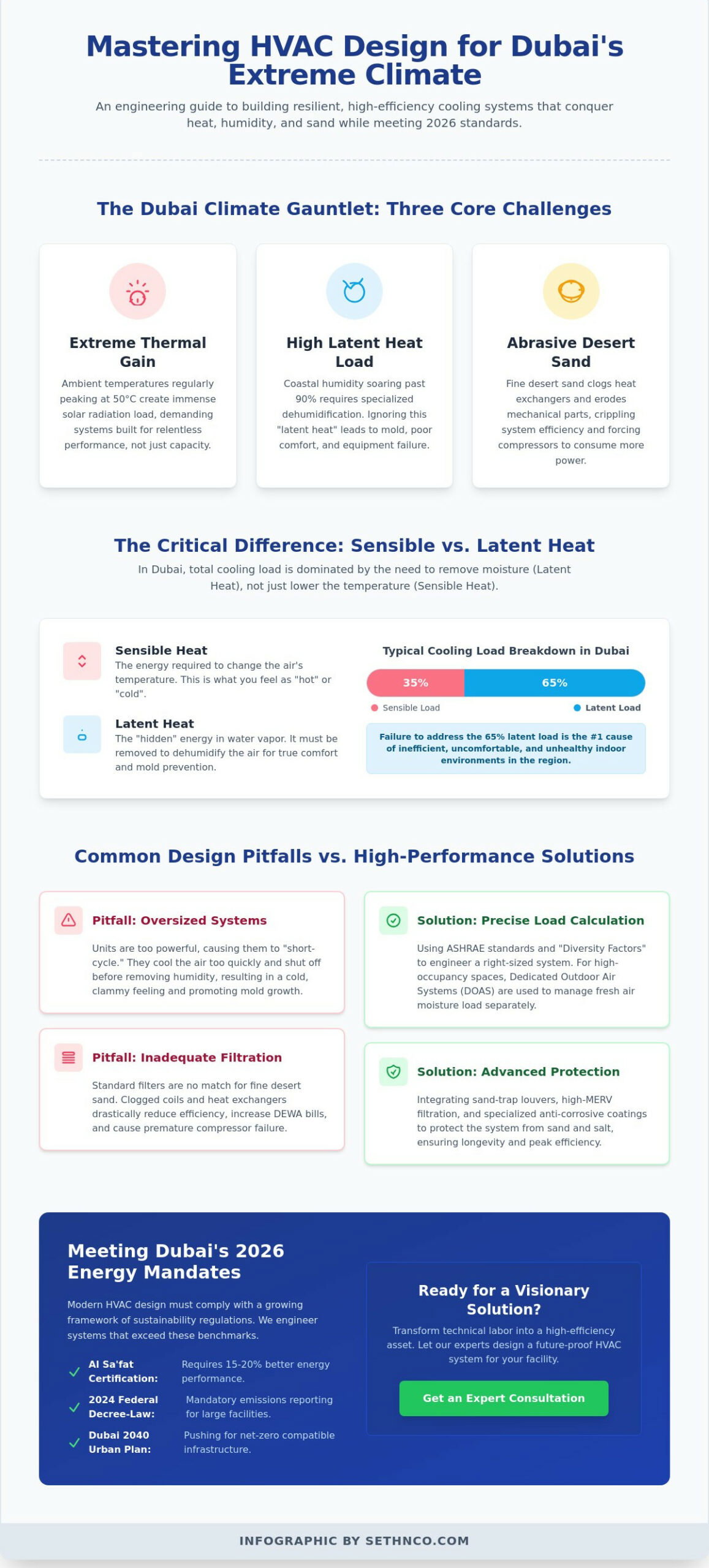
In Dubai, HVAC engineering is a high-stakes discipline where ambient temperatures regularly peak at 50°C and coastal humidity levels soar past 90%. This environment demands more than just standard cooling; it requires a specialized approach to hvac system design for dubai climate that accounts for extreme thermal gain and relentless atmospheric moisture. The Dubai 2040 Urban Master Plan has further intensified these requirements, pushing for sustainable urban development that aligns with the UAE’s commitment to net-zero goals. Under the 2024 Federal Decree-Law on climate, facilities consuming over 50,000 MWh annually must report greenhouse gas emissions, and achieving Al Sa’fat certification now requires demonstrating 15-20% better energy performance than baseline standards.
Engineers face three primary stressors: extreme thermal gain from solar radiation, humidity-induced mold growth, and abrasive desert dust. A successful strategy for hvac system design for dubai climate must prioritize the Core Engineering Principles of HVAC, specifically the distinction between sensible and latent heat. While sensible heat refers to the measurable change in temperature, latent heat involves the energy required to remove moisture from the air. In a coastal desert, ignoring the latent load results in systems that fail to provide true comfort while consuming excessive power.
The Latent Heat Load Factor
Humidity in coastal Dubai significantly increases the energy required to achieve indoor comfort. A common mistake is installing oversized systems; these units reach the thermostat setpoint too quickly, shutting down before they’ve had sufficient time to dehumidify the space. This leaves the air feeling “clammy” and promotes mold growth. For high-occupancy commercial buildings, we integrate Dedicated Outdoor Air Systems (DOAS) to handle the fresh air moisture load separately, ensuring precise control over indoor air quality and preventing the saturation of building materials.
Sand and Dust: The Invisible Efficiency Killers
Fine desert sand is a constant threat to mechanical integrity. It clogs heat exchangers and reduces airflow, forcing compressors to work harder and consume more energy. Effective design incorporates sand-trap louvers and high-MERV filtration to capture particulates before they enter the ductwork. These choices directly impact the frequency of required duct cleaning dubai services. Working with experienced mep contractors ensures your system is built to withstand these abrasive conditions while maintaining peak operational efficiency.
Core Engineering Principles for High-Performance HVAC
High-efficiency hvac system design for dubai climate begins with precise cooling load calculations. We rely on ASHRAE standards specifically tailored for the Middle East to account for the region’s extreme ambient conditions. Over-designing is a common pitfall; it leads to short-cycling and poor humidity control. By applying “Diversity Factors,” our engineers calculate the difference between peak instantaneous loads and actual average usage. This ensures the system handles the hottest July afternoon without being inefficiently oversized for the rest of the year. It’s about finding the “sweet spot” where capacity meets actual demand.
A building’s envelope is the first line of defense. Analyzing thermal insulation and glazing performance allows us to reduce the total cooling requirement before a single duct is installed. Integrating energy-efficient cooling strategies into the architectural shell minimizes heat gain. This proactive approach lowers both initial capital expenditure and ongoing operational costs. When the building’s skin works with the mechanical systems, the result is a more resilient and sustainable indoor environment.
MEP Integration: A Holistic Approach
HVAC doesn’t exist in a vacuum. It relies on a delicate synergy with electrical and plumbing systems. Electrical capacity must handle high-torque compressor starts, while plumbing drainage must be perfectly pitched to prevent condensate leaks in the ceiling. Poor coordination between trades often results in system failures that are difficult to rectify post-construction. At Sethnco, our 20+ years of experience as mep contractors allows us to oversee these complex intersections with total precision. If you’re planning a new development, our team can help you navigate these integrated electromechanical requirements from the very first draft.
Zoning Strategies for Dubai Properties
Large villas and commercial offices rarely have uniform occupancy. Effective zoning allows for precise temperature control where it’s needed most. We utilize Variable Air Volume (VAV) systems to modulate airflow based on real-time demand. Using advanced thermal modeling, we predict the sun-path’s impact on specific building zones throughout the day. This ensures that west-facing glass facades receive extra cooling in the afternoon without freezing the rest of the floor. It’s a sophisticated way to maintain comfort while slashing DEWA bills and extending the life of your hvac system design for dubai climate.
Selecting the Right HVAC Configuration for Your Property
Choosing the right hardware is the engine of your building’s comfort. For a successful hvac system design for dubai climate, you must select a configuration that balances initial capital expenditure with long-term operational costs. The three dominant systems in the UAE market, Variable Refrigerant Flow (VRF), Air-Cooled Chillers, and Ducted Splits, each serve distinct architectural needs. While ducted splits remain popular for smaller residential units due to their lower upfront costs, they often struggle with efficiency during 50°C summer peaks. In contrast, centralized systems offer superior energy efficiency ratios (EER) and are designed specifically to thrive under extreme thermal stress.
For commercial properties, the ROI of high-efficiency configurations is realized quickly through reduced DEWA expenses. In high-density areas like Downtown or Dubai Marina, district cooling integration is often the mandate. This requires a specialized design approach, focusing on heat exchangers and internal fan coil unit (FCU) layouts rather than standalone outdoor condensers. As of 2026, air-cooled systems must meet a minimum Coefficient of Performance (COP) of 3.00 to 3.40, while water-cooled plants are held to a much higher standard of 5.50 to 6.20. These metrics aren’t just numbers; they’re the benchmarks for a sustainable future.
VRF Systems: The Flexibility Leader
Variable Refrigerant Flow (VRF) technology is the gold standard for luxury villas and mid-sized commercial developments. Its primary advantage lies in its ability to handle partial load conditions with extreme precision. Rather than running at full capacity, the system modulates the flow of refrigerant to match the exact cooling demand of each room. This results in significant power savings. It’s important to remember that the complexity of VRF refrigerant piping requires expert installation to prevent leaks. This makes the choice of an experienced engineering partner vital for long-term reliability.
Chiller Systems for Large-Scale Cooling
When cooling high-rise towers or large industrial facilities, centralized chiller plants are the most effective solution. These systems require robust mechanical plant room planning and careful consideration of water treatment protocols. A well-designed chiller plant provides the dependable backbone of a building’s functionality. Because these systems are major assets, we emphasize the importance of chiller maintenance and repair accessibility during the initial design phase. Ensuring that components are easy to reach and service prevents expensive downtime during the peak summer months.
Critical Design Features for Efficiency and Longevity
A resilient hvac system design for dubai climate must prioritize more than just cooling capacity; it requires a strategic selection of features that protect the mechanical investment from the UAE’s aggressive environment. Longevity in this region is often cut short by salt-air corrosion and fine particulate infiltration. By integrating specific protective measures during the engineering phase, property owners can ensure their systems operate at peak efficiency for years rather than months. This proactive approach transforms a standard installation into a high-performance asset that withstands 50°C summers without breaking down.
Energy Recovery Ventilation (ERV) is a non-negotiable feature for modern Dubai buildings. These systems allow for the mandatory intake of fresh outdoor air without losing the cooling energy already spent on the indoor environment. By exchanging heat and moisture between the incoming and outgoing air streams, ERVs significantly reduce the load on the main cooling plant. Additionally, we specify “Blue Fin” or “Gold Fin” anti-corrosive coatings for all condenser coils. These specialized epoxy layers are vital for coastal properties where salty humidity can cause rapid oxidation and pitting of aluminum fins, leading to a catastrophic loss of heat transfer efficiency. Designing with serviceability in mind also ensures that your property remains compliant with a comprehensive ac maintenance contract dubai, as accessible components are more likely to be serviced correctly.
Smart Controls and IoT Integration
Modern Building Management Systems (BMS) have moved beyond simple scheduling. Today’s smart controls utilize ambient sensors and occupancy data to optimize energy consumption in real-time. This shift toward predictive maintenance allows the system to alert operators to minor pressure drops or motor inefficiencies before they lead to a total shutdown. Integrating these controls with smart home platforms also gives owners the power to manage their DEWA consumption remotely, ensuring that cooling is only delivered when and where it’s needed.
Material Selection for Harsh Environments
The desert sun is as damaging to materials as the heat is to people. We utilize UV-resistant materials for all outdoor units and exposed refrigerant piping to prevent insulation degradation. High-quality, closed-cell insulation is essential for chilled water pipes to stop condensation from forming in high-humidity conditions. Furthermore, selecting non-porous duct materials and ensuring proper sealing prevents the microbial growth that often plagues poorly designed systems in the Gulf. These material choices are the backbone of a system that remains healthy and efficient over a 15-year lifecycle.
If you’re looking to upgrade your property’s resilience, our team can help you select a tailored Annual Maintenance Contract (AMC) that covers these critical design features and ensures your system continues to thrive.
The Sethnco Approach: Expert Design and Execution
Falling into the “Dubai AC Trap” is a costly mistake many property owners realize only after their first peak-summer utility bill arrives. This trap consists of high operational costs paired with underwhelming indoor comfort, usually caused by undersized ductwork or over-tonnage units that fail to dehumidify. Avoiding these pitfalls requires more than just a standard installation; it demands a visionary approach to hvac system design for dubai climate that prioritizes technical precision from the initial load calculation to the final commissioning. At Sethnco, we frame our mechanical services as a contribution to your building’s long-term functionality rather than a series of transactional repairs. We act as the dependable backbone of your facility, ensuring every component is optimized for the desert’s unique thermal demands.
Our end-to-end execution process is built on a foundation of rigorous engineering. We begin with detailed energy modeling and ASHRAE-standard load calculations to determine the exact requirements of your space. This data-driven phase informs the selection of high-efficiency hardware and the layout of integrated MEP systems. By getting the engineering right at the start, we significantly reduce the long-term ac maintenance cost dubai property owners often face. A well-designed system experiences less mechanical stress, fewer component failures, and lower energy consumption, providing a seamless path from installation to years of reliable operation.
Technical Excellence Since 1998
We’ve navigated the complexities of the regional infrastructure scene for over two decades. This deep industry tenure allows us to deliver results that align perfectly with the latest UAE green building codes and Al Sa’fat energy benchmarks. Our team handles both the design and installation phases, ensuring that the original engineering intent is never lost during the construction process. This comprehensive, all-encompassing service model provides our clients with a single point of accountability and the reassurance that their hvac system design for dubai climate is being executed by seasoned veterans who know exactly how to deliver perfection.
Your Path to a Seamless Climate Solution
The most successful projects involve our engineering team during the early stages of the building lifecycle. Early-stage involvement allows us to coordinate with architects and developers to integrate cooling requirements into the building’s structural and electrical plans, preventing expensive retrofits later. Whether you’re planning a luxury residential villa or a large-scale commercial development, our pragmatic experts are ready to provide the technical guidance you need. We invite you to Consult with Sethnco for your HVAC design needs and secure a climate solution that thrives in the extreme heat of the Emirates.
Secure Your Building’s Operational Future
Mastering hvac system design for dubai climate requires a shift from basic cooling to comprehensive environmental control. We’ve explored how balancing latent heat loads and implementing protective measures like anti-corrosive coatings are essential for surviving the coastal desert’s unique stressors. By choosing a configuration that matches your specific occupancy patterns and building envelope, you ensure a high-efficiency result that meets the rigorous 2026 UAE energy standards. This isn’t just about comfort; it’s about building a resilient, cost-effective infrastructure that stands the test of time.
As specialists in energy-efficient cooling with over 25 years of localized UAE experience, Sethnco provides the comprehensive MEP and HVAC expertise required for complex regional projects. Our team acts as your dependable partner, translating technical requirements into seamless operational success. Don’t leave your facility’s performance to chance. Get a Professional HVAC Design Consultation from Sethnco today to optimize your system for peak efficiency. We’re ready to help you build a visionary climate solution that delivers quiet strength and reliable performance for years to come.
Frequently Asked Questions
How does the Dubai climate specifically affect HVAC design?
Dubai’s climate necessitates high-ambient cooling capacities and robust dehumidification to handle 50°C temperatures and humidity levels that often exceed 90% in coastal areas. Standard systems designed for temperate zones fail here because their condensers can’t reject heat efficiently in extreme ambient conditions. A successful hvac system design for dubai climate must account for these extremes to prevent compressor burnout during peak summer months.
What is the most energy-efficient HVAC system for a villa in Dubai?
Variable Refrigerant Flow (VRF) systems are currently the most energy-efficient choice for luxury villas in Dubai. These systems utilize inverter technology to modulate refrigerant flow based on the specific cooling demand of each room, avoiding the energy waste of traditional on-off cycles. This precision allows for significant power savings during partial load conditions, which represent the majority of the operating year in the UAE.
Why is humidity control as important as temperature in UAE HVAC design?
Humidity represents the “latent” heat load that temperature-only sensors often ignore, making it a critical factor in indoor comfort and health. In the UAE, unmanaged humidity leads to mold growth and a “clammy” indoor feeling even if the air is technically cool. Proper engineering ensures the evaporator coil stays at the correct dew point to extract moisture effectively before the air is circulated through the building.
Can a poorly designed HVAC system increase my DEWA bill?
Yes, a poorly designed system can drastically increase your DEWA bill by forcing the compressor to run longer or more frequently than necessary. Oversized systems short-cycle, consuming massive amounts of startup power without cooling the space efficiently. Conversely, undersized systems run 24/7 without ever reaching the setpoint, leading to excessive energy consumption and premature mechanical wear.
What are sand-trap louvers and why are they necessary in Dubai?
Sand-trap louvers are specialized intake vents designed to separate desert sand and large particulates from the air stream before they reach the primary filters. In Dubai, these are essential for preventing abrasive sand from clogging heat exchangers and damaging internal fan motors. They act as the first line of defense, significantly extending the time between required filter cleanings and protecting the system’s overall airflow efficiency.
How long does a professionally designed HVAC system last in the UAE?
A professionally designed HVAC system in the UAE typically lasts between 12 to 15 years when paired with a consistent maintenance strategy. Systems that aren’t specifically engineered for the local environment often fail within 5 to 7 years due to salt-air corrosion and extreme thermal stress. Investing in high-quality materials and anti-corrosive coatings during the design phase is the most effective way to protect your long-term capital investment.
Is VRF better than a traditional Chiller system for Dubai buildings?
The choice between VRF and Chiller systems depends primarily on the scale and usage of the property. VRF offers superior flexibility and efficiency for villas and mid-sized commercial buildings with diverse occupancy needs. Traditional water-cooled chillers remain the gold standard for high-rise towers and large-scale industrial plants where centralized cooling provides the best economy of scale and meets high-tonnage requirements.
What are the legal requirements for commercial HVAC design in Dubai?
Commercial hvac system design for dubai climate must comply with the 2024 UAE Climate Law and the revised 2025 Dubai Municipality Building Energy Code. These regulations mandate specific energy performance benchmarks and, for facilities consuming over 50,000 MWh annually, mandatory greenhouse gas emissions reporting. Additionally, central chiller plants must meet strict minimum Coefficient of Performance (COP) values to achieve legal compliance and Al Sa’fat certification.


