

How to Reduce DEWA Bill in Summer: The Expert Dubai Guide (2026)
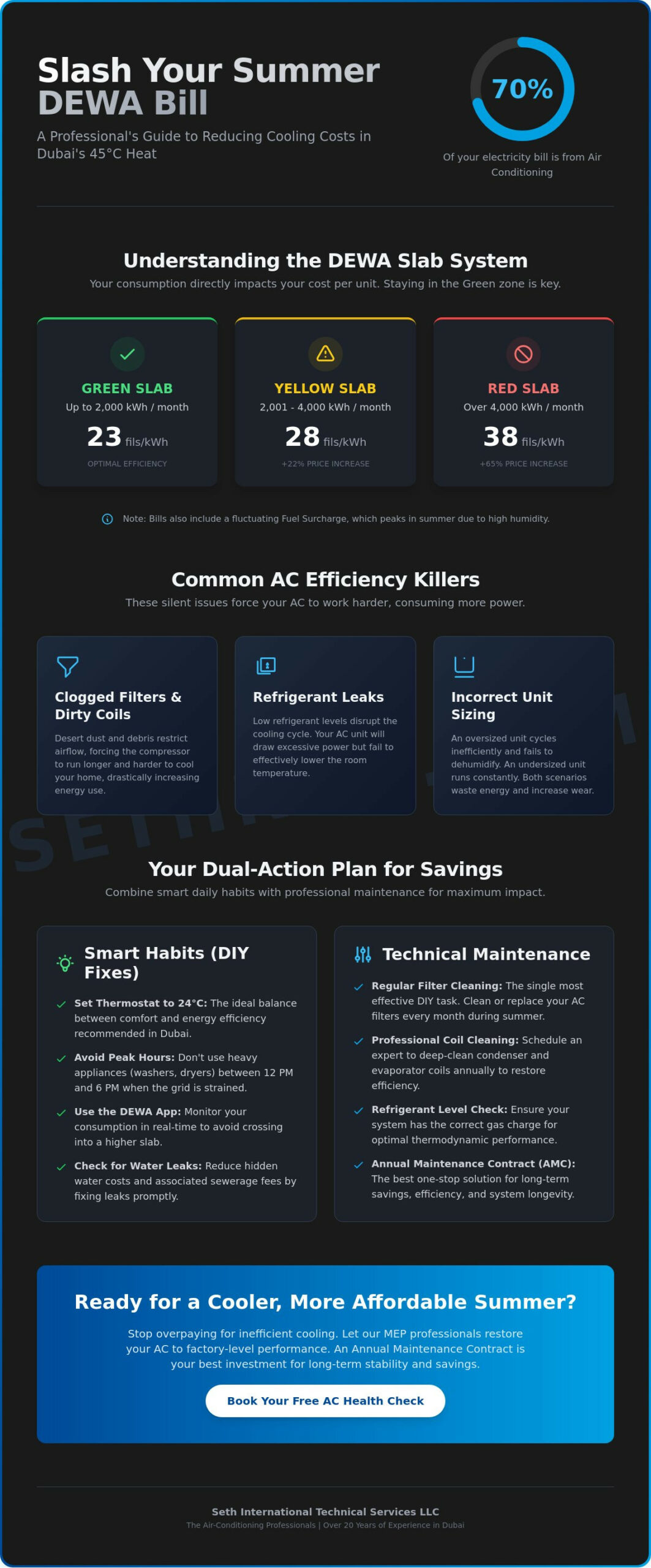
According to DEWA efficiency data, air conditioning accounts for up to 70% of a Dubai household’s electricity consumption during the peak heat of August. It’s a common frustration to see your monthly statement climb into higher tariff slabs while your AC units struggle to keep pace with the 45 degree Celsius heat. You’re likely tired of paying exponentially high fees for a system that runs 24/7 but fails to deliver crisp, clean air. If you’re looking for how to reduce dewa bill in summer, you need more than just basic tips; you need a professional MEP strategy.
As the architects of a better future with over 20 years of experience, we understand the technical nuances of the Dubai climate. We’ve developed this one-stop solution to help you master both behavioral shifts and mechanical optimizations to slash your cooling costs. You’ll learn exactly how to lower your monthly AED payments, extend your AC lifespan, and improve your indoor air quality. From recalibrating your VRV systems to navigating the latest 2026 tariff structures, this guide provides the professional roadmap you need for a cooler, more affordable summer.
Key Takeaways
- Decode the DEWA slab system and fuel surcharges to understand exactly how summer humidity and tiered pricing drive up your monthly utility costs.
- Recognize the technical reality that AC systems consume up to 70% of your energy and learn to identify efficiency-draining issues like clogged filters and dirty coils.
- Master how to reduce dewa bill in summer through a dual approach that combines simple behavioral habits with strategic technical upgrades to your home’s cooling envelope.
- Follow a professional step-by-step checklist to conduct a DIY home energy audit and secure your HVAC system’s performance before the May temperature spike.
- Explore how professional MEP solutions and Annual Maintenance Contracts (AMC) provide a one-stop solution for long-term energy stability and factory-level efficiency.
Understanding the DEWA Slab System and Summer Tariffs in Dubai
Managing utility costs in the UAE requires more than just turning off lights. As a professional MEP partner with twenty years of experience in the Dubai market, Seth Int’l understands that thermal loads during July and August put immense pressure on local infrastructure. To effectively learn how to reduce dewa bill in summer, you must first decode the tiered pricing structure that governs your monthly statement. Dubai utility costs aren’t flat; they’re designed to penalize high consumption during the harshest months.
The 2026 DEWA Slab Structure Explained
The DEWA slab system is a progressive tariff structure where the cost per unit increases as your total monthly consumption crosses specific thresholds. For residential apartments in 2026, the Green slab covers consumption up to 2,000 kWh at a rate of 23 fils per unit. Once you exceed this, you enter the Yellow slab (2,001 to 4,000 kWh) at 28 fils. If your AC system isn’t optimized and your usage exceeds 4,000 kWh, you hit the Red slab, where the rate jumps to 38 fils per unit. Crossing into this highest tier can increase your electricity costs by over 65 percent compared to the base rate. Applying basic principles of energy conservation is essential to keep your household within the Green or Yellow categories.
Your bill also includes a Fuel Surcharge, which is directly impacted by Dubai’s summer humidity. High humidity levels force HVAC systems to work harder to dehumidify the air, increasing the total energy load. This surcharge fluctuates based on global fuel prices but consistently peaks during the summer months when demand is highest. We also see a distinct difference between villa and apartment tariffs. Villas often have higher thresholds for their slabs but face much larger cooling requirements for open spaces and high ceilings.
Water Consumption and Sewerage Fees
Water usage is the second pillar of your summer expenses. Residents frequently overlook how garden irrigation and pool evaporation during 45°C days drive up the “Sewerage Fee,” which is calculated as a percentage of your total water consumption. In Dubai, this fee is typically 0.5 fils per gallon of water used. If you’re losing 100 gallons a day to evaporation or hidden leaks, you’re paying for that water twice: once at the tap and once as a sewerage charge.
To master how to reduce dewa bill in summer, use the DEWA Smart Living dashboard to monitor for “High Usage” alerts. These notifications often signal hidden leaks in underground pipes or faulty float valves in water tanks. As your one-stop solution for plumbing and mechanical health, we recommend checking these digital logs weekly. Identifying a leak in June can save you thousands of Dirhams by the time September arrives. Our mission as architects of a better future is to help you transition from reactive repairs to proactive efficiency.
- Peak Hours: Avoid using heavy appliances like washing machines or dishwashers between 12 PM and 6 PM.
- Slab Monitoring: Check your DEWA app mid-month to see if you’re approaching the Red slab threshold.
- Surcharge Awareness: Remember that every extra kWh used during high-humidity days carries a higher fuel surcharge.
Why Your AC System is the Primary Driver of High DEWA Bills
In Dubai’s extreme 45°C summer heat, your HVAC system isn’t just a luxury; it’s a critical utility that dictates your monthly expenses. Technical data from regional energy audits shows that air conditioning accounts for up to 70% of a home’s total electricity consumption during the peak months of June through September. If you’re looking for how to reduce dewa bill in summer, you must focus on the mechanical efficiency of your cooling plant. When condenser coils are caked in desert dust or filters are clogged, the compressor is forced to run longer cycles. It struggles to reject heat, pulling significantly more AED from your wallet every hour it operates.
Refrigerant leaks are another silent thief of efficiency. Low gas levels destroy the thermodynamic cycle, forcing the unit to draw excessive power without actually lowering the room temperature. Unit sizing is equally vital. An oversized unit cycles on and off too rapidly, which fails to remove humidity and wears out the starter capacitor. An undersized unit simply never stops running. Both scenarios lead to inflated DEWA statements. Following expert Summer Energy-Saving Tips can help you identify these mechanical bottlenecks before they lead to a mid-August breakdown.
The Hidden Cost of Dirty AC Ducts
Dust accumulation inside your ductwork creates a physical barrier that restricts airflow. This increases what engineers call static pressure. When static pressure rises, the blower motor must work 15% harder to push conditioned air into your living spaces. This extra electrical load is a direct contributor to high bills. Professional duct sanitization removes these obstructions and ensures your system functions as a high-performance, one-stop solution for home comfort. Clean ducts reduce the strain on the entire HVAC infrastructure, lowering your daily kilowatt-hour consumption.
Thermostat Wars: Setting the Ideal Temperature
Many Dubai residents set their AC to 18°C or 20°C, unaware of the steep financial consequences. The science is clear: 24°C is the “Goldilocks” zone for desert climates. For every single degree you drop the thermostat below 24°C, your cooling costs can climb by 5% to 8% based on current DEWA tariff slabs. Smart thermostats are essential in this environment. They allow the system to enter an eco-mode when the villa or apartment is empty, preventing wasted energy. As architects of a better future, we believe in precision cooling that respects both the environment and your budget. If your system still feels inefficient despite these changes, a professional HVAC inspection can pinpoint the exact cause of your high consumption.
Habitual vs. Technical Fixes: A Dual Approach to Savings
Achieving a lower utility statement requires more than just turning off a few lights. You need a balanced strategy that combines daily discipline with structural efficiency. Most residents ask how to reduce dewa bill in summer by changing their habits, but behavior alone cannot overcome a failing HVAC system or poor insulation. Total optimization requires a dual approach. We view the home as a “Cooling Envelope.” If this envelope is compromised by leaks or outdated machinery, your manual efforts will yield diminishing returns. This is why professional MEP support is vital for long-term sustainability. You should implement a seasonal plan by April. This ensures your home is ready before the 45°C June humidity spikes.
Behavioral Habits for Immediate Savings
Daily habits provide the quickest path to minor reductions. Solar heat gain is a primary enemy in Dubai. Heavy curtains and blackout blinds can block up to 80% of external thermal radiation. Don’t run heat-generating appliances like dryers or dishwashers during the peak heat of the afternoon. These machines raise the internal temperature, forcing your AC to work harder to maintain the set point. Use the “Away Mode” strategy for your thermostat. Setting the temperature to 25°C while the home is empty prevents the structure from absorbing too much heat. It’s far more efficient than turning the system off entirely and forcing a “crash cool” cycle later in the evening.
Technical Upgrades for Long-Term ROI
If your cooling equipment is over ten years old, it’s likely a primary driver of high costs. Replacing outdated units with high-efficiency split systems or VRV (Variable Refrigerant Volume) technology can reduce energy consumption by 30% to 40%. Our team at Seth Int’l acts as the architects of a better future by optimizing these complex systems. We provide a one-stop solution that bridges the gap between simple habits and professional engineering. Key technical steps include:
- Sealing the Envelope: Applying weather stripping and high-performance caulking to windows and doors prevents cold air from escaping.
- LED Transitions: Traditional bulbs convert 90% of energy into heat. Switching to LEDs reduces the internal heat load that your HVAC must neutralize.
- Smart Controls: Installing programmable thermostats allows for precision cooling based on occupancy patterns.
Technical upgrades represent a “Quality services @ cheap prices” philosophy over the long term. While they require an initial investment, the reduction in monthly DEWA overhead often pays for the upgrades within two summer seasons. This technical precision is how to reduce dewa bill in summer while maintaining the premium comfort expected in the Dubai climate.
Step-by-Step Summer Efficiency Checklist for Dubai Residents
Lowering your energy consumption requires a structured plan rather than guesswork. You can start by using the DEWA app to perform a DIY home energy audit. This digital tool provides a detailed breakdown of your usage patterns and identifies where your home loses the most energy. You must schedule a professional HVAC maintenance visit before May begins. This ensures your system is primed for the 45 degree Celsius peaks that define the Dubai summer. Following a rigorous schedule is the best way to understand how to reduce dewa bill in summer without sacrificing indoor comfort.
- Replace filters: Clean or replace all AC filters every 30 days during peak summer months.
- Seal the envelope: Use weatherstripping to seal air leaks around balcony doors and window frames.
- Upgrade technology: Switch to energy-efficient appliances that carry high ESMA star ratings.
- Calibrate thermostats: Set your AC to 24 degrees Celsius to balance comfort and cost.
Monthly Maintenance Tasks
Cleaning a standard AC filter requires a gentle touch. Remove the mesh and rinse it under lukewarm water. Don’t use harsh chemicals or stiff brushes, as these can tear the delicate material. Let the filters dry completely before reinstalling them. You should also check your outdoor condenser unit for sand buildup or obstructions. Clear airflow is essential for the heat exchange process. Monitor the DEWA Smart Living dashboard weekly. It flags unusual consumption spikes before they turn into expensive monthly surprises. This habit is a core part of how to reduce dewa bill in summer effectively.
When to Call a Professional MEP Contractor
Some technical issues fall outside the scope of DIY maintenance. You should watch for signs of a failing compressor, such as unusual grinding noises or frequent cycling every 4 to 6 minutes. If you notice “hot spots” in specific rooms, it often indicates a duct leak or insulation failure. We offer a one-stop solution for these complex mechanical challenges. Our technicians inspect electrical connections to prevent power surges that can fry expensive VRV systems. As architects of a better future, we provide quality services @ cheap prices to ensure your home remains a sanctuary. For comprehensive system optimization, book our expert HVAC maintenance services today.
Professional Solutions: How Sethnco Reduces Your Long-Term Costs
While basic habits help, professional intervention is the most effective way to address how to reduce dewa bill in summer permanently. Most HVAC systems in Dubai lose about 5% efficiency every year without expert care. Sethnco provides an Annual Maintenance Contract (AMC) that acts as a shield against this decline. Our technicians restore factory-level efficiency by performing deep AC duct cleaning and coil descaling. These procedures ensure your system doesn’t overwork to reach your desired temperature, which can lower energy consumption by 15% to 25% during peak heat months. We believe that quality services @ cheap prices shouldn’t be a contradiction; we provide the technical excellence required to keep your costs low without the premium price tag.
It’s common for residents to choose “cheap” emergency repairs when a unit fails. These quick fixes often ignore the root cause of high energy consumption, such as refrigerant leaks or faulty capacitors. Sethnco takes a different approach. We focus on long-term energy stability. By optimizing your HVAC design and ensuring every component operates at its peak, we prevent the gradual creep of your DEWA costs. Our 20-year legacy in the UAE market allows us to identify these inefficiencies before they become expensive problems.
Comprehensive MEP Audits
Sethnco engineers conduct detailed energy audits that go far beyond a visual check. We utilize thermal imaging to identify heat ingress points and perform load testing on your electrical panels. This data-driven approach allows us to provide customized recommendations for retrofitting older Dubai properties. Whether it’s upgrading to VRV systems or replacing outdated MEP components, our goal is seamless execution. We maintain total transparency in our pricing, ensuring you receive high-tier engineering solutions that fit your budget. Our audits often reveal that simple technical adjustments can significantly impact how to reduce dewa bill in summer without requiring a total system overhaul.
The Sethnco “One-Stop Solution” Advantage
Efficiency isn’t just about one machine; it’s about how your entire building functions. As a one-stop solution provider, we integrate HVAC, electrical, and plumbing services to ensure total building efficiency. This holistic strategy prevents energy waste that occurs when systems work against each other. We’ve spent two decades acting as architects of a better future in Dubai, building a reputation as the most trusted service provider in the region. We go above and beyond to anticipate your needs, ensuring your home remains a sanctuary of comfort even when temperatures exceed 45°C.
Don’t wait for your next high bill to take action. Contact Sethnco today for a professional AC maintenance checkup and start saving on your utility costs immediately.
Master Your Cooling Efficiency Today
Managing high utility costs in the UAE requires a strategic blend of technical precision and daily habits. Understanding the DEWA slab system is the first step toward real savings. By prioritizing HVAC performance, you prevent energy consumption from spiraling during peak heat months. Implementing behavioral changes alongside professional maintenance is the most effective strategy for how to reduce dewa bill in summer. Sethnco is your one-stop solution. We bring 20+ years of Dubai technical expertise to every project. Our certified HVAC and MEP specialists are trusted by commercial and residential clients across the UAE to deliver quality services @ cheap prices. As architects of a better future, we ensure your systems operate at peak efficiency. Don’t let a neglected unit drain your budget. Book Your Professional AC Maintenance with Sethnco to secure long-term reliability and comfort. You’ve got the expert support needed to stay cool and cost-effective all season long.
Frequently Asked Questions
What is the most energy-efficient temperature for my AC in Dubai?
The most energy-efficient temperature for your AC in Dubai is 24°C. Setting your thermostat to this level provides the ideal balance between internal comfort and operational cost. DEWA data indicates that every degree you set above 24°C can save you up to 9% on your cooling costs. This simple adjustment is a vital step in learning how to reduce dewa bill in summer during the peak heat months of July and August.
How often should I clean my AC ducts to save on DEWA bills?
You should clean your AC ducts at least every 6 months to maintain peak efficiency. Dust and debris accumulation in the ductwork forces your HVAC system to work 15% harder to circulate air through your home. Our technical teams at Seth Int’l recommend a professional deep clean twice a year to prevent airflow restrictions. This proactive maintenance ensures your system doesn’t waste energy pushing air through clogged and dirty passages.
Does DEWA charge more for electricity during the daytime in summer?
DEWA doesn’t currently apply higher tariff rates for daytime electricity usage for residential customers. While they encourage reducing consumption during peak load hours from 12 PM to 6 PM, your billing remains based on your total monthly consumption slabs. Shifting heavy appliance use to evening hours helps the national grid but doesn’t change your specific per-unit cost. You’ll still pay the same rate regardless of the time of day you use power.
Can a faulty water heater increase my electricity bill even if I dont use hot water?
A faulty water heater can significantly increase your electricity bill even if you never turn on the hot water tap. If the internal thermostat fails, the heating element may stay active 24 hours a day to maintain a high temperature. This hidden malfunction can add between AED 40 and AED 85 to your monthly bill depending on the unit’s wattage. Regular plumbing inspections prevent these phantom costs from draining your monthly household budget.
Is it cheaper to leave the AC on all day or turn it off when I leave?
It’s cheaper to leave your AC on at a higher temperature, such as 27°C, rather than turning it off completely when you leave for work. Cooling a room from 35°C back down to 24°C requires your compressor to run at maximum capacity for several hours. Maintaining a steady, moderate temperature prevents the walls and furniture from absorbing heat. This is a professional secret for how to reduce dewa bill in summer effectively and consistently.
What are the DEWA slab rates for 2026?
The DEWA slab rates for 2026 remain structured to reward lower consumption across the city. For residential apartments, the first 2,000 kWh are charged at 0.23 fils per kWh. Usage between 2,001 and 4,000 kWh costs 0.28 fils, while consumption exceeding 6,000 kWh reaches the top slab of 0.38 fils per kWh. These tiered rates ensure that high-usage households pay a premium. Monitoring your monthly consumption helps you stay within the affordable lower tiers.
How much can I save by switching to LED lights in my Dubai apartment?
Switching to LED lights in a standard two-bedroom Dubai apartment can save you approximately AED 350 to AED 500 per year. LEDs use 80% less energy than traditional incandescent bulbs and produce significantly less heat. This reduction in ambient heat also lowers the load on your AC system, providing a secondary saving on your monthly statement. It’s a one-stop solution for long-term energy efficiency that pays for itself within a few months.
Why is my DEWA fuel surcharge so high in July and August?
Your fuel surcharge is higher in July and August because it’s calculated based on your total electricity and water consumption. As your AC works harder to combat 45°C outdoor temperatures, your total kWh usage spikes. Since the surcharge is a flat rate per kWh, your total payment for this line item increases proportionally with your summer energy demand. It’s a pass-through cost that directly reflects the increased fuel needed for power generation during peak periods.


